

Your website is often the first real interaction a potential client has with your company. For service businesses especially, that first impression shapes whether someone stays to learn more or moves on to the next provider in their search.
One of the earliest decisions in any website project is whether to build custom or use a template. Both are valid approaches. The right choice depends on where your business is now, where it's headed, and what your website actually needs to do.
What Is a Template Website?
A template website uses a pre-designed layout that you customise with your own content, colours, and images. Platforms like WordPress, Wix, and Squarespace offer thousands of templates designed for different industries and use cases.
Template web design gives you a functional, professional-looking site quickly. The structure, navigation patterns, and page layouts are already built. Your job is to fill in the content and adjust the visual details to match your brand.
For many service businesses, especially those in their early stages, a well-chosen template is a smart starting point.
What Is a Custom Website?
A custom website is designed and built from scratch to match your specific brand, audience, and business goals. There's no pre-set layout to work within. Every page, every interaction, and every content structure is purpose-built.
Custom web design services typically involve a web design agency or an experienced design and development team who study your business, research your audience, and build a site tailored to how your clients actually evaluate and choose a provider.
For service businesses with complex offerings, multiple audiences, or ambitious growth plans, a custom build provides the flexibility and precision that templates can't match.
Key Differences
Design Flexibility
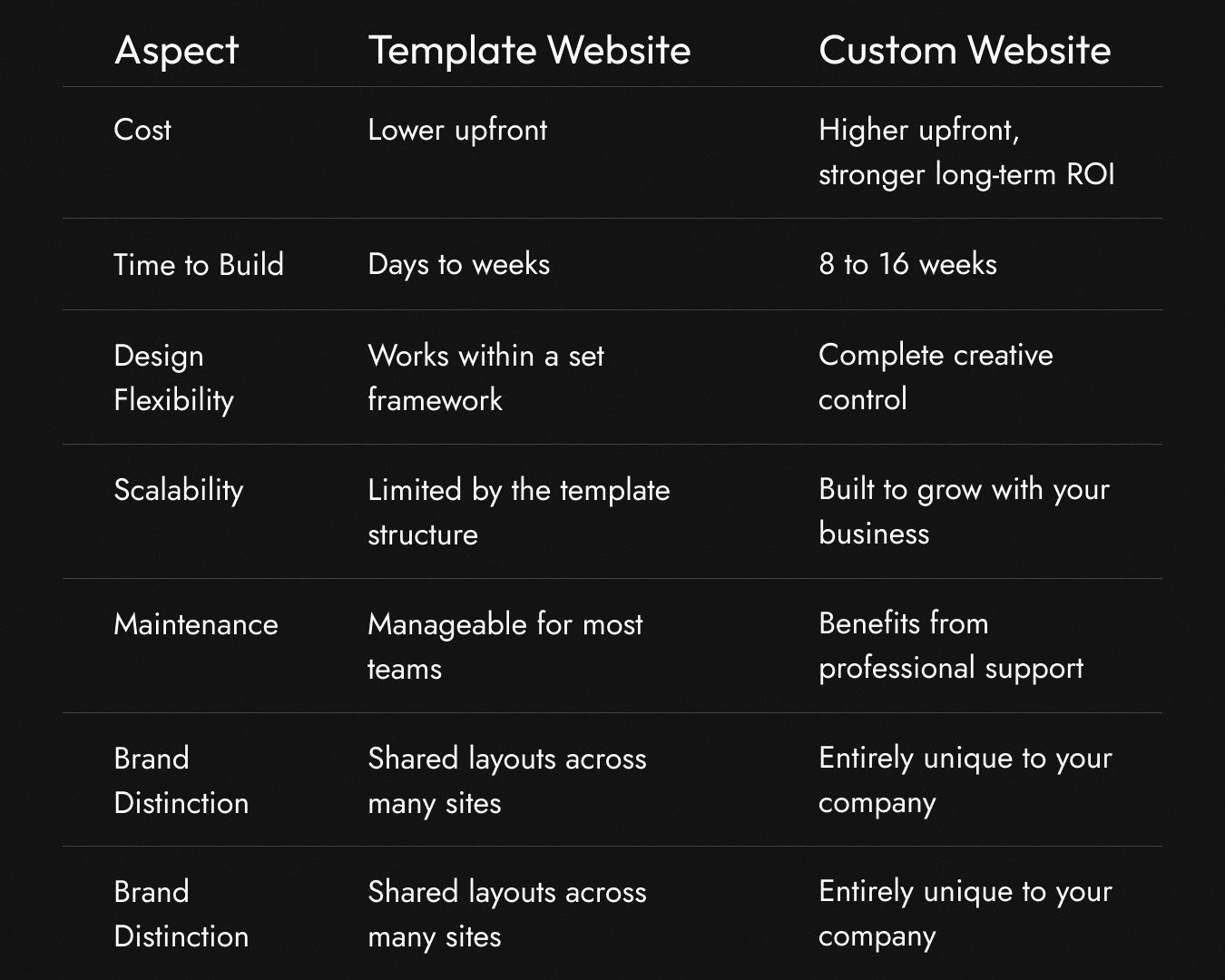
Template web design gives you a solid starting point, but the layout options are finite. You're working within a framework someone else designed for a general audience. Customisation is possible, but there are boundaries.
Custom web design services give you complete creative control. Every element is designed around your brand identity, your content structure, and your audience's behaviour. Nothing is compromised to fit a pre-existing framework.
Development Time
A template website can be live in days or weeks. If your priority is speed, this is a clear advantage. For businesses that need a professional presence quickly, template web design delivers.
A custom website typically takes 8 to 16 weeks depending on scope. The longer timeline reflects the research, strategy, and bespoke design work that goes into building something tailored. The investment in time produces a site that's built for the long term.
Cost
Template websites are more affordable upfront. Platform subscriptions, a premium theme, and some configuration can get you a functional site for a modest investment.
Custom web design services require a higher initial investment. For service businesses working with a web design agency, engagements typically start at $10,000 and scale based on complexity. The return comes through stronger brand perception, better conversion rates, and a site that scales with your business.
Performance and SEO
Templates often include features and code you'll never use, which can affect page speed and search performance. Some templates are well-optimised; many aren't.
Custom websites are built lean. Every line of code serves a purpose. A web design agency building custom will optimise for Core Web Vitals, technical SEO, and mobile performance from the start, giving you a stronger foundation for search visibility.
Maintenance
Template websites are generally easier to maintain day to day. Platform updates, plugin management, and content changes are straightforward for most teams.
Custom websites require more intentional maintenance. Security updates, performance monitoring, and feature additions benefit from professional support. Many businesses working with a web design agency retain ongoing maintenance to keep their custom site running well.
A Side-by-Side Comparison
Which Is Right for Your Service Business?
A template website makes sense if:
You're in the early stages of your business and need a professional online presence quickly. Your budget is limited and your service offering is straightforward. You don't need complex functionality, custom integrations, or a multi-audience site structure. Template web design gives you a credible starting point that you can build from as your business grows.
Custom web design services make sense if:
Your company has grown and your current site no longer reflects the quality of your work. You have multiple service lines, distinct audience segments, or specific functionality requirements that templates can't accommodate. You're investing in your brand as a long-term business asset and you want a website that positions your company with precision. Working with a web design agency gives you the strategic thinking and technical execution to build something that genuinely supports your growth.
The Choice Isn't Always Binary
It's worth noting that the line between template and custom isn't always sharp. Many service businesses start with a template and graduate to a custom build as they grow. Others use a template-based platform like WordPress or Webflow but invest in custom web design services to make the site feel and function as if it were built from scratch.
The platform matters less than the thinking behind it. A well-designed template site with strong strategy, clear messaging, and intentional content architecture will outperform a poorly planned custom site every time.
What matters most is that your website accurately represents your business, speaks clearly to your audience, and makes it easy for the right people to take the next step.
Making the Decision
Before choosing between custom and template, consider these questions:
Has your business outgrown what your current site communicates? Do your clients frequently comment that your website doesn't reflect the quality of your work? Are you losing opportunities because prospects can't quickly understand what you do and who you do it for?
If the answer to any of those is yes, it may be time to invest in a website that's built around your business rather than adapted from a general-purpose template.
If you're earlier in your journey and need something functional and professional now, a template is a perfectly valid starting point. The important thing is to choose intentionally, not by default.