

If you are a B2B expert, you don’t need more "awareness." You need more intent.
Most agencies and consultants treat their branding strategy as a cosmetic exercise, a new logo or a fresh color palette. But in a high-stakes B2B environment, "pretty" doesn't pay. If your brand looks great but your calendar is empty, there is a disconnect between your visual identity and your prospect’s psychology.
To win in 2026, your brand must act as a 24/7 sales representative that bridges the gap between a curious click and a committed discovery call.
What is a B2B Branding Strategy?
In a professional services context, a branding strategy is a psychological framework used to establish authority and reduce the perceived risk of a purchase. Unlike consumer branding, which relies on impulse, B2B branding uses conversion psychology to prove competence and move a prospect from anonymous visitor to a qualified lead.
Key Takeaway: A modern B2B branding strategy is a lead-generation tool designed to reduce buyer friction, not just an aesthetic upgrade.
Why Traditional Branding Fails the "Discovery Call" Test
Most B2B websites suffer from the "Generic Expert" syndrome. They use headlines like "We provide world-class solutions." From a psychological perspective, this creates Cognitive Friction. Because you look like everyone else, the prospect’s brain cannot categorize you as a "specialist."
When a brand fails to differentiate, the prospect defaults to the only metric left: price. As noted in recent Harvard Business Review studies on B2B buyer behavior, professional buyers now complete nearly 70% of their journey before ever speaking to a salesperson. If your branding isn't doing the heavy lifting early, you've already lost the deal.
Key Takeaway: If your brand doesn't immediately signal a specific solution to a specific problem, you will be forced to compete on price rather than expertise.
3 Conversion Psychology Principles Every Brand Needs
To turn a visitor into a lead, your branding must leverage how the human brain makes high-stakes decisions.
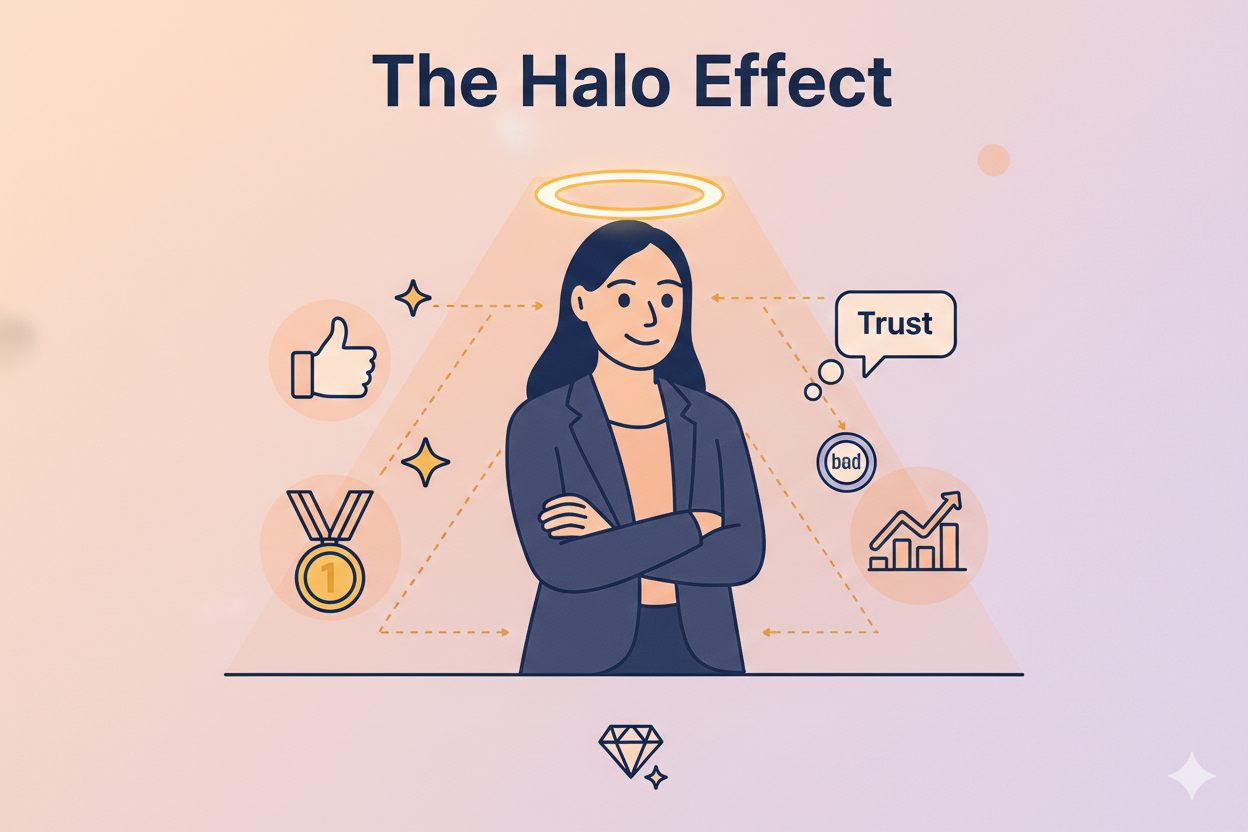
1. The Halo Effect
If your visual identity looks premium and organized, prospects subconsciously assume your service delivery is also premium.
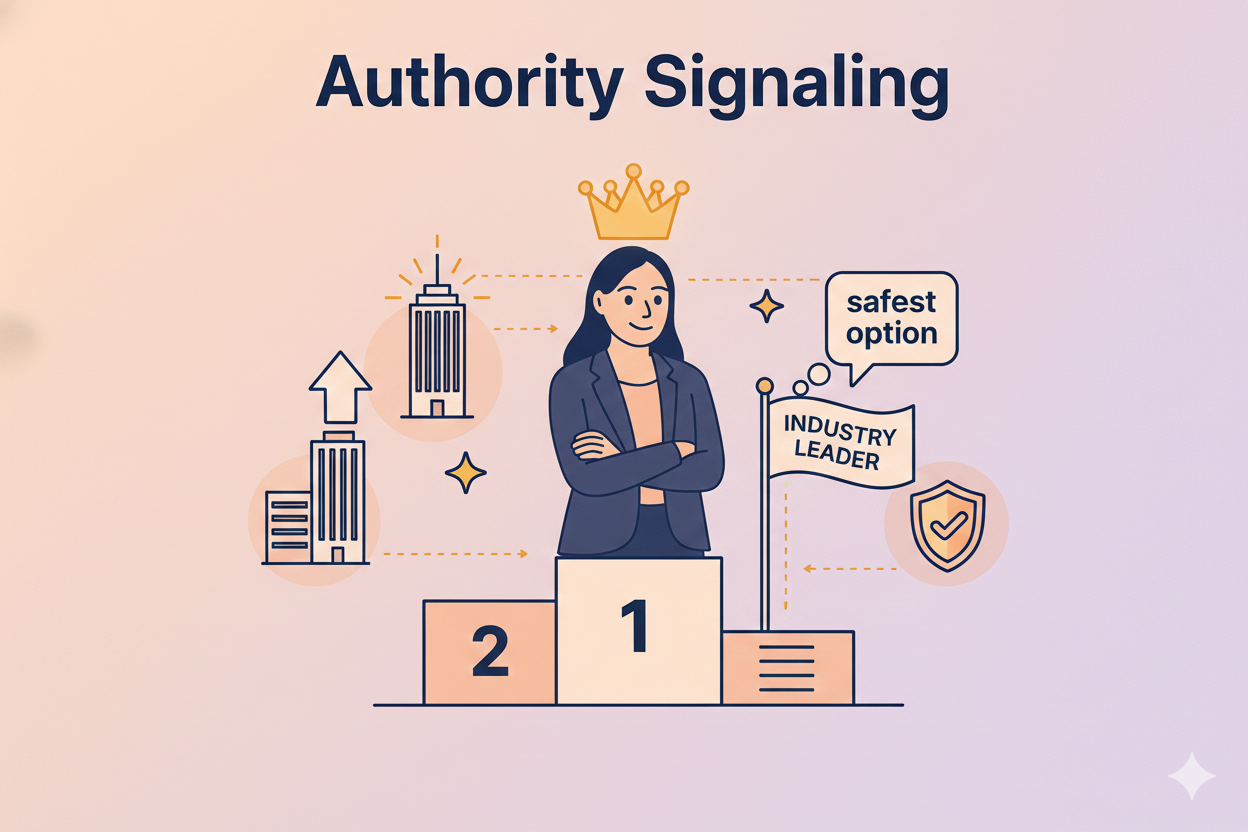
2. Authority Signaling
B2B buyers aren't looking for the "best" option; they are looking for the "safest" option. You must move from "we provide a service" to "we lead the industry."
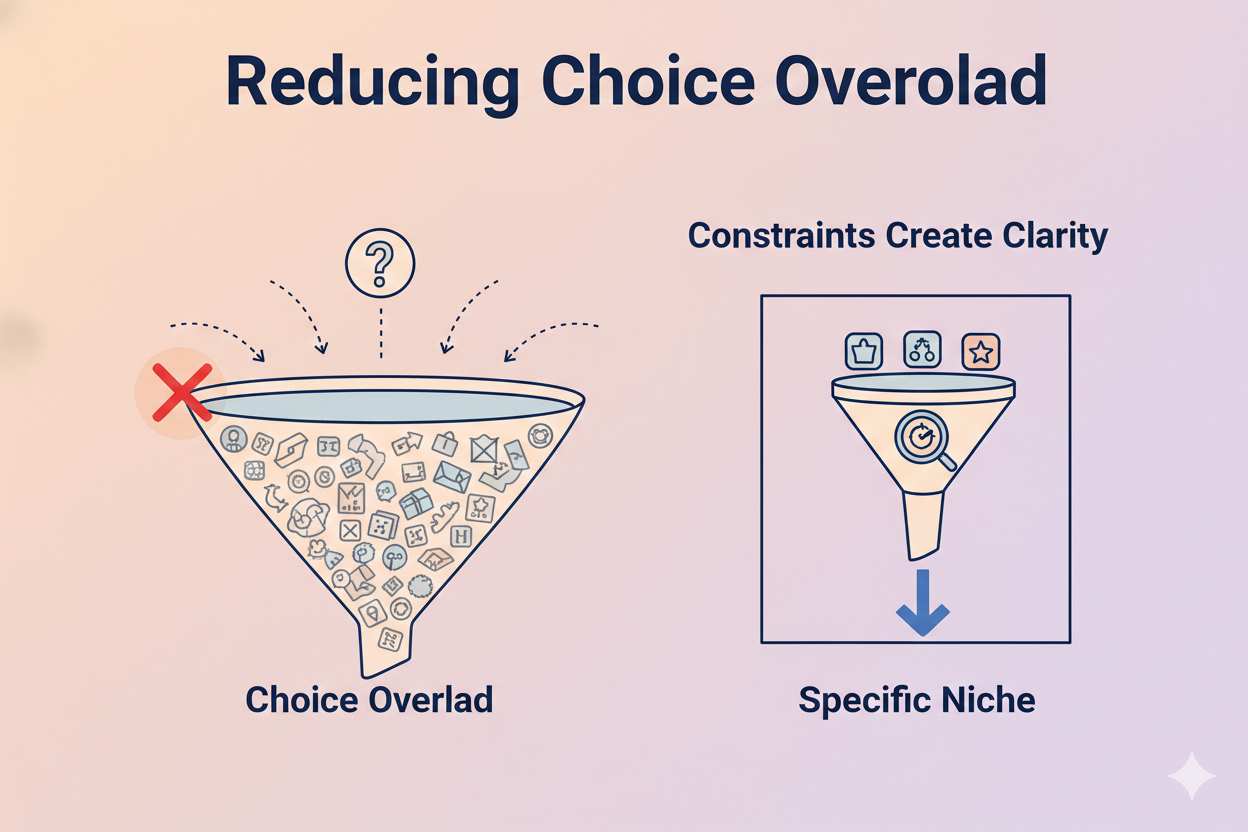
3. Reducing Choice Overload
Constraints create clarity. By narrowing your brand’s focus to a specific niche, you make the decision-making process easier for the client.
Key Takeaway: Leveraging psychological triggers like the Halo Effect allows your brand to build "silent trust" before the first interaction.
Our Take: Why "Pretty" Branding is a Liability
Agency Insights: We’ve seen many firms spend $10k+ on a rebrand that looks like a masterpiece but kills their conversion rate. Why? Because they prioritized "minimalist aesthetics" over Information Density. In B2B, a prospect is looking for evidence. If you hide your expertise behind white space and vague slogans to look "clean," you are essentially hiding your value. Our stance: If a design element doesn't help a prospect trust you more, it doesn't belong on the page.
Key Takeaway: In 2026, the most successful brands prioritize "clarity over cleverness" to ensure they don't lose prospects to confusion.
The "Discovery Call" Framework: A 3-Step Execution
To turn your brand into a lead-generation engine, follow this production checklist:
- The Result-Oriented Headline: Swap "What we do" for "What you get."
- The Micro-Conversion Path: Use your brand to offer a "low-friction" win first, such as a video case study.
- Intent-Based Design: Use "Intent-Based" language. Instead of "Contact Us," use "Check Our Availability."
Key Takeaway: Successful brand execution requires moving prospects through small "micro-wins" that build the momentum needed to book a call.
Comparison: Generic Branding vs. Conversion-First Branding
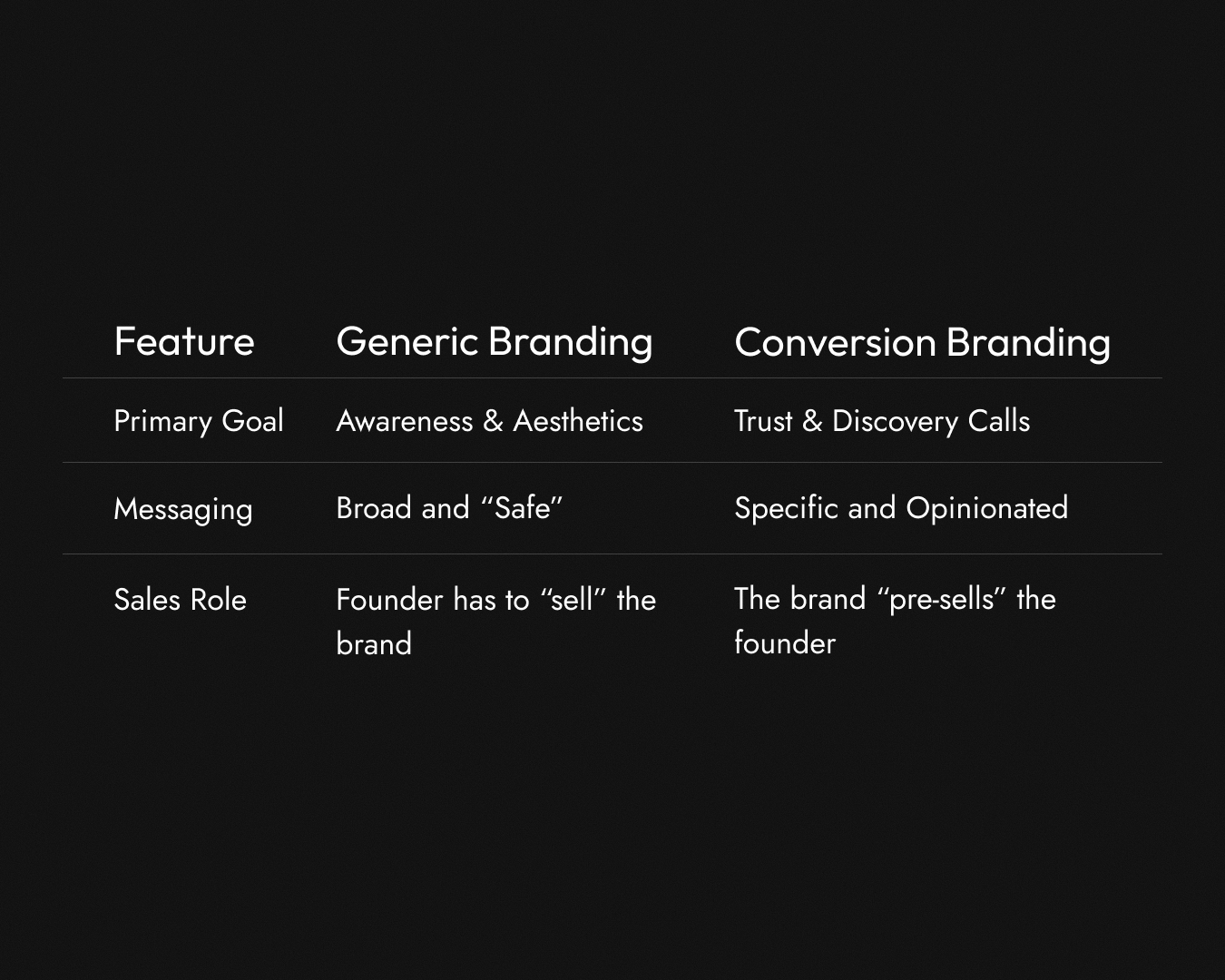
Key Takeaway: Conversion-first branding acts as a filter that attracts high-value partners and repels low-budget "tire-kickers."
The Bottom Line
A branding strategy that doesn't result in more discovery calls is just an expensive art project. By applying conversion psychology, focusing on authority, reducing risk, and narrowing your niche, you transform your brand from a digital brochure into a strategic asset that builds your pipeline while you sleep.
FAQs
What are the 4 branding strategies?
In classic marketing (often referred to as the Ansoff Matrix applied to branding), these strategies determine how you grow based on your product and your market:
- Line Extension: Adding new items in the same product category under the same brand name (e.g., an SEO agency adding a "Local SEO" specific service).
- Brand Extension: Using an existing successful brand name to launch a product in a new category (e.g., a Branding agency launching a proprietary Project Management software).
- Multi-branding: Developing different brand names for products in the same category to lock out competitors (e.g., a large agency holding company owning three different boutique firms that technically compete).
- New Brands: Creating an entirely new brand name when entering a new market where the old brand name isn't a fit.
What are the 7 commonly used branding strategies?
Beyond the high-level growth strategies, these 7 styles represent how a brand actually "lives" in the market:
- Personal Branding: Centered around an individual (perfect for founder-led agencies).
- Product Branding: Focusing on the specific tool or service rather than the company.
- Corporate Branding: The overall reputation of the entire organization.
- Service Branding: Focusing on the experience and the deliverables (critical for B2B agencies).
- Co-Branding: A partnership between two brands (e.g., your agency partnering with a software like HubSpot).
- No-Brand Branding: A minimalist approach where the "lack" of branding is the brand (think "Generic" or "White Label" services).
- Geographic Branding: Using a specific location to build trust (e.g., "The Premier London Creative Shop").
What are the 4 C's of brand strategy?
While the 4 P's (Product, Price, Place, Promotion) are for marketing, the 4 C's are specifically designed to ensure your branding strategy is client-centric.
- Clarity: Is your message simple? Can a prospect understand what you do in 5 seconds? (This solves the "generic" pain point).
- Consistency: Does your brand look and sound the same on LinkedIn, your website, and your sales decks?
- Character: What is the "human" element of your brand? Why should a client like you? (This is the Authority piece).
- Commitment: Does the brand deliver on its promises over the long term? (This is the Retention piece).